

Article: The Garment Remembers
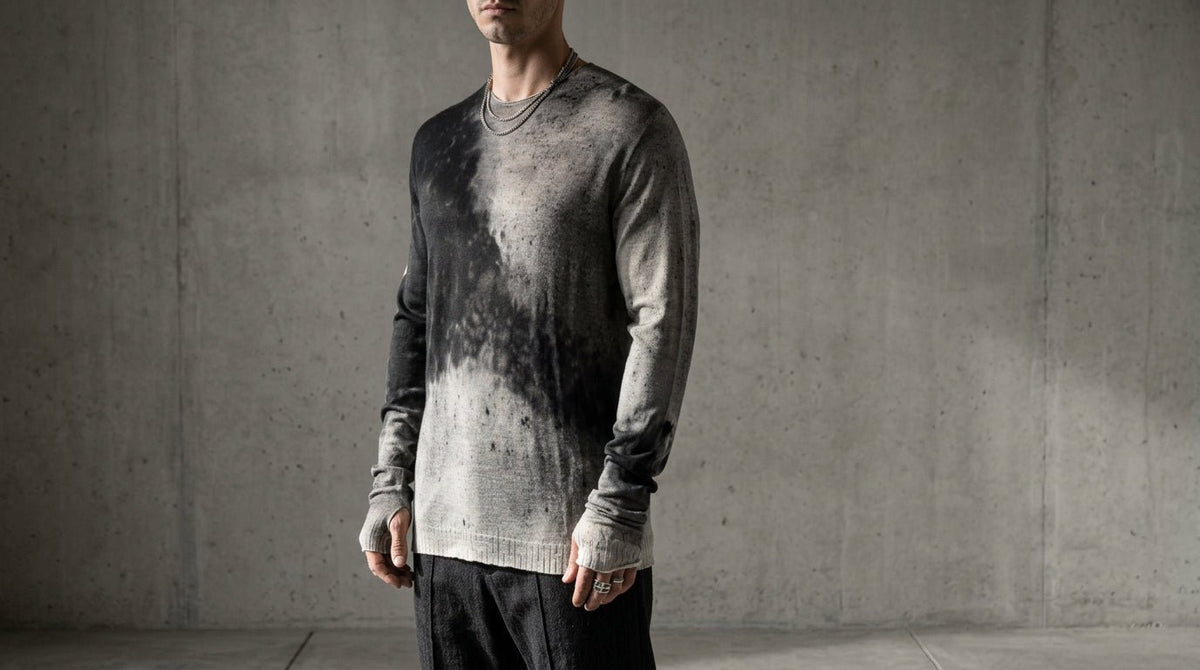
The Garment Remembers
There is a kind of darkness that only appears after prolonged contact with skin.
MD75 begins where most knitwear ends — at the point of collapse. Cold-dyed yarns submerged until they forget their original colour. Resin applied not as protection but as memory, hardening along the creases where the body insists on itself. Hand-painted surfaces that refuse the notion of a finished object.
You don't wear these pieces. You enter a negotiation with them.
The silhouettes are architectural in the way ruins are architectural — they imply a structure that has already been through something. Elongated, asymmetric, draped with the kind of severity that reads as tenderness from a distance. The proportions don't flatter. They propose.
Somewhere in the flat industrial plains south of Modena, in a region that has produced knitwear for generations, something else is happening. Not refinement. Erosion.
This is what interests us.
A piece of MD75 purchased today will not be the same piece in a year. The dye continues its work in the dark of your closet. The resin softens where you bend. The distressing answers to your life, not the designer's. There is no final form. The garment is a process wearing the shape of a sweater.
No lookbooks circulate. No campaigns interrupt your feed. The name itself — MD75 — offers nothing, explains nothing, sells nothing. It sits there like a coordinate or a frequency, waiting to be received rather than understood.
We carry very few things that behave this way. Clothing that becomes more itself through disappearance — through the slow act of being worn until it is indistinguishable from the body beneath it.
What remains when a garment stops being visible and starts being felt?